
Top 5 Terraform Workflow Tools You Should Know in 2025
Every engineering org eventually hits the same Terraform wall:
As you scale, infrastructure becomes harder to reason about, PR reviews slow down, governance gets reactive, and every team wants “self-service” without the risk. That’s where Terraform workflow platforms come in. These tools don’t replace Terraform; they solve the surrounding lifecycle: workspaces, policies, automation, promotion flows, and team coordination.
Here are the top 5 Terraform workflow engines to know in 2025, how they differ, and when each one actually makes sense.
1. Terraform Cloud / Terraform Enterprise
Official site: https://www.hashicorp.com/products/terraform
Angle: The “official” Terraform workflow engine.
Terraform Cloud (TFC) and Enterprise (TFE) offer the most opinionated, integrated Terraform experience:
- Remote state & locking
- Workspace-based pipelines
- First-party cost estimation
- Run Tasks for pre-apply checks
- Sentinel policy-as-code
- Strong audit, RBAC, SSO/SAML
Teams that pick TFC/TFE want a unified Terraform lifecycle and are comfortable adopting the HashiCorp workflow model.
Why it matters:
It’s the reference architecture for Terraform workflows, the baseline every other tool is compared against.
2. Spacelift
Official site: https://spacelift.io
Angle: The most flexible Terraform-native workflow engine.
Spacelift is popular with platform engineering teams because it supports:
- Terraform, Terragrunt, OpenTofu, Pulumi, Kubernetes
- Flexible pipelines + custom runners
- Stack dependencies & multi-stack orchestration
- Drift detection + auto-remediation
- OPA/Rego policy enforcement
- Strong GitOps alignment
Developers like it because it feels natural in Git.
Platform teams like it because it provides pipeline power without having to build pipelines manually.
Why it matters:
The pick for teams that want customization without owning the entire automation layer.
3. Atlantis
Official site: https://www.runatlantis.io/
Angle: The OG of PR-based Terraform automation.
Atlantis is as close to “pure GitOps Terraform automation” as you can get:
- Self-hosted
- PR comments trigger plan / apply
- No vendor lock-in
- Minimal UI, minimal friction
If a team says:
“We want full control and don’t want a SaaS workflow engine.”
…they’re usually running Atlantis.
Why it matters:
Still, the fastest way to run Terraform securely inside your own walls.
4. Env0
Official site: https://www.env0.com
Angle: Terraform as a self-service platform for developers.
Env0 is built around controlled autonomy:
- Permissions, approvals, RBAC
- Budget guardrails and cost transparency
- Reusable modules & templates
- Self-service infra provisioning
- Multi-cloud visibility
It treats Terraform like a product that developers can safely consume, with platform teams setting standards and constraints.
Why it matters:
Perfect for teams rolling out developer-facing self-service infrastructure.
5. Scalr
Official site: https://www.scalr.com
Angle: Enterprise-first workflows with governance as the priority.
Scalr focuses on:
- Global policies and organizational standards
- Multi-cloud governance
- Workspace and environment consistency
- Cost visibility
- Workflow standardization at scale
Enterprises choose Scalr when they want Terraform workflows without Terraform Cloud but still need strong compliance and audit capabilities.
Why it matters:
A strong fit for companies with heavy governance requirements and complex org structures.
How to integrate Terracotta AI across your Terraform Workflow Tools
Terracotta AI is not a workflow engine.
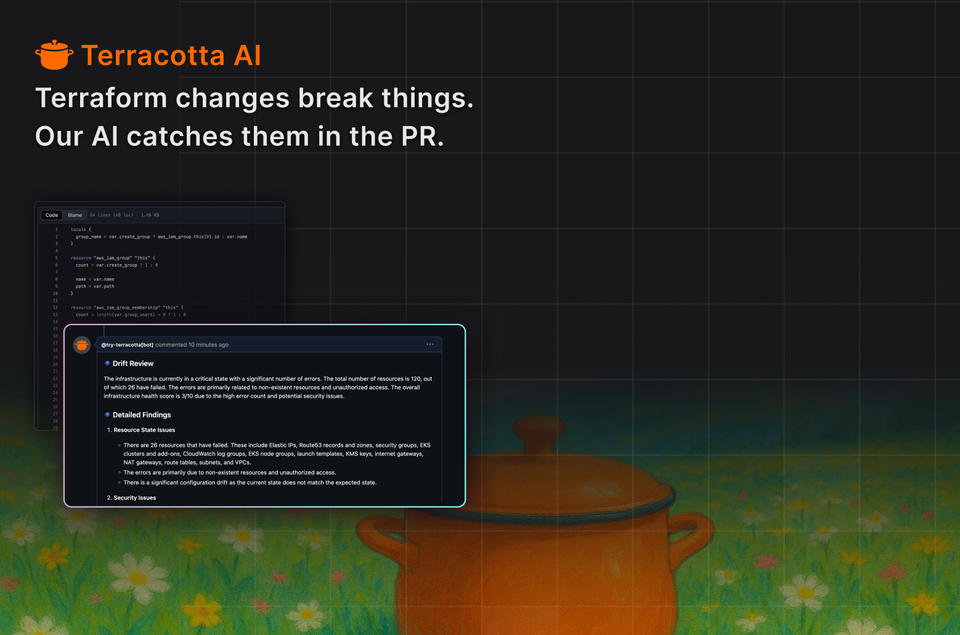
It’s the pre-merge intelligence layer that runs before any of the tools above, sanitizing and enforcing best practices, so by the time your workflows trigger, they become sanity checks for your Terraform.
With the Terracotta API, you can connect your workflow outputs, contextualizing your workflow and test output directly from your CI tool. This extension of AI functionality allows teams to generate meaningful insight in the form of a retrospective after the CI has triggered.
With Terracotta AI, you get both pre-flight and post-merge sanity checks across your entire IaC pipeline, giving you real insight and confidence from your IaC workflows.
You can think of it like this:
- Terracotta AI = Pre-Flight Review layer
- TFC / Spacelift / Atlantis / Env0 / Scalr = Execution layer
Terracotta plugs directly into GitHub/GitLab and provides:
- Natural-language summaries of Terraform changes
- Drift detection before CI/CD
- Security, cost, and compliance natural-language guardrail enforcement in the PR
- Policy-as-code using natural language, OPA, Sentinal and more
- Automatic runbooks that explain the reasoning and intent behind recommended fixes
Terracotta AI is fully CI/CD-agnostic; it works with all five tools because it runs before they do.
If workflow tools answer:
“How should we run Terraform?”
Terracotta answers:
“Is this Terraform safe to run?”
Wrapping Up
Each Terraform workflow engine solves a different problem:
In 2025, Terraform workflows aren’t solved by choosing one tool.
They’re solved by pairing the right execution engine with the proper pre-merge guardrails and clarity.


Comments ()